.svg)
.svg)
.svg)
.svg)

.png)
Let us hold your hand when we say this: most marketing frameworks feel like they were written by robots, for robots.
You know what we're talking about. Those stiff, corporate explanations that make you feel like you need an MBA just to understand how to sell your own product. The ones that forget you're a human building something you actually care about.
But here's the thing - the marketing mix doesn't have to be that way.
The marketing mix definition is actually pretty straightforward: it's a strategic framework that helps you make smart decisions about your product, pricing, distribution, and promotion. Think of it as your marketing strategy blueprint, the foundation that keeps all your marketing efforts aligned and purposeful.
And yes, before you ask - this framework absolutely works for real businesses. Not just the Fortune 500 companies. We're talking about solopreneurs, small teams, and anyone building something meaningful.
What Is the Marketing Mix, Really?
The marketing mix is a set of marketing tools that work together to help you reach your target market and achieve your marketing objectives. Instead of manipulating people into buying things they don't need (please, we have enough of that), it focuses on understanding what your customers actually want and positioning your offering in a way that creates genuine value.
Originally coined by Neil Borden in 1953 and refined by E. Jerome McCarthy in his 1960 book Basic Marketing: A Managerial Approach, the marketing mix has been guiding successful marketing strategy development for over 60 years. The American Marketing Association recognizes it as one of the fundamental concepts in marketing management.
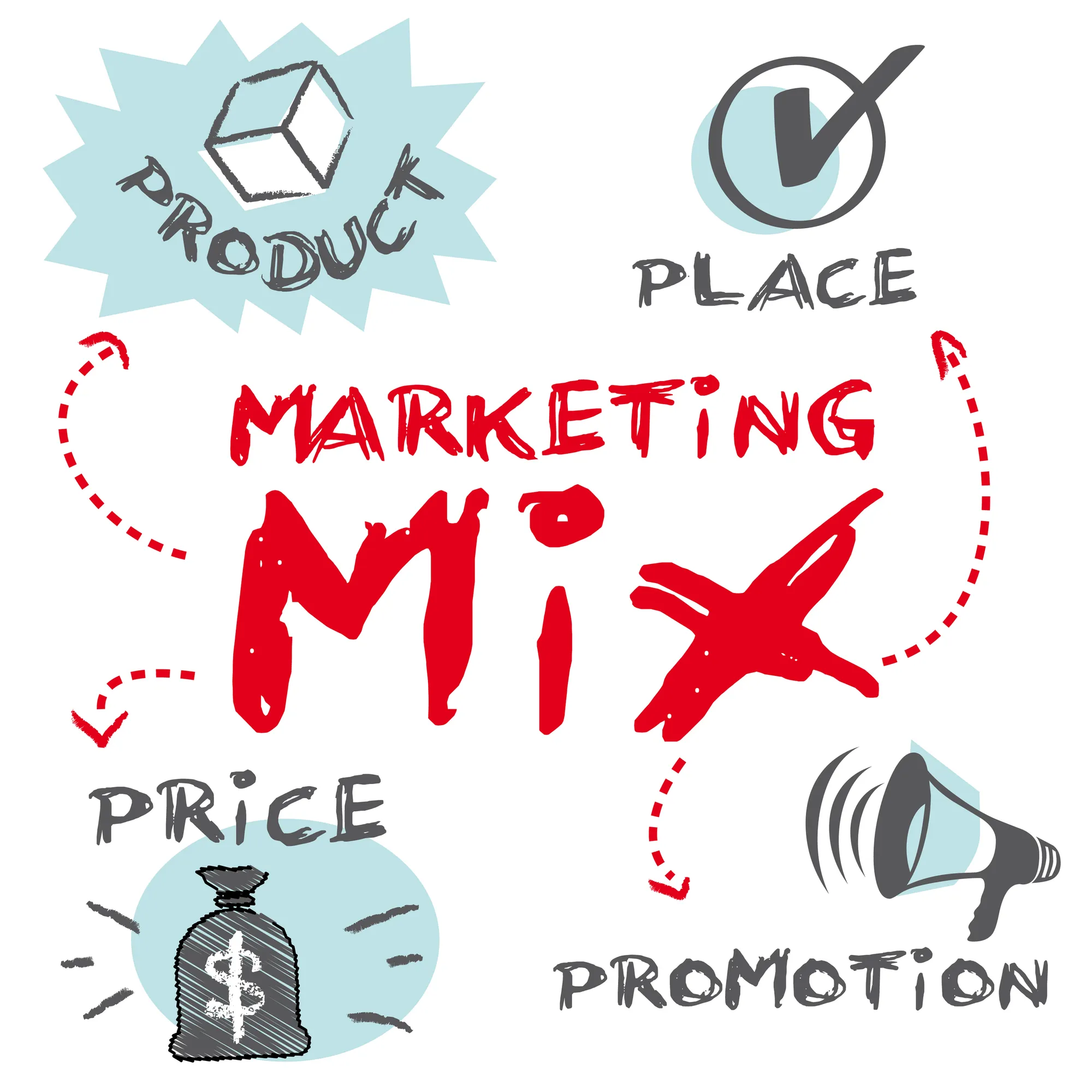
The framework is built on four core elements - what we call the 4 Ps of marketing:
- Product - What you're selling (tangible or intangible)
- Price - What you're charging for it
- Place - Where and how customers can access it
- Promotion - How you communicate its value
These marketing mix elements work as deeply interconnected parts of your overall marketing plan, creating a cohesive customer experience together.
The 4 Ps of the Marketing Mix (Explained Like You're Human)
Product: What Are You Actually Offering?
Your product represents the transformation you're creating, the problem you're solving, and the relief you're providing.
When we talk about a product in the marketing mix, we're considering everything: design, quality, features, packaging, branding, and how it fits into your customer's life. Are you meeting customer needs? Does your product create the outcome people are actually looking for?
Real talk: Before you obsess over fancy features, ask yourself what emotional outcome your product delivers. People don't subscribe to meal kit services because they love following recipe cards. They buy them because they want to feel like a competent home cook without the mental load of meal planning. They want to stop feeling guilty about ordering takeout for the third night in a row.
That's what product strategy is really about - understanding the deeper why behind what you're selling.
Price: The Value Exchange
Pricing goes beyond covering costs or matching competitors. Your price communicates value, positions your brand, and directly impacts both customer perception and your bottom line.
When you're developing your pricing strategy, you're balancing multiple factors:
- Production costs and profit margins
- What the market will bear
- How potential customers perceive value
- Whether you're positioning as premium or accessible
- Your long-term business sustainability
Here's what most pricing guides won't tell you: Your price creates expectations. Price too low, and people question your quality. Price too high without justification, and you price yourself out. The sweet spot lives where your value proposition meets your customer's willingness to pay.
Place: Making Your Product Accessible
Place (also called distribution) is where your product meets your customer. It's about convenience, accessibility, and creating a frictionless path to purchase.
In today's world, place extends far beyond the physical store versus e-commerce debate. You need to understand where your target market naturally shops, what distribution channels they trust, and how to make your product available at the right time and location.
Consider: Are your customers browsing Instagram shops at midnight? Visiting farmers' markets on weekends? Searching Amazon for solutions? Your distribution strategy needs to match their actual shopping behavior, not where you wish they'd shop.
Promotion: Creating Meaningful Connections
This is where most businesses go wrong. They think promotion means shouting louder than everyone else, posting more generic AI-generated content, or running ads until they run out of budget.
Effective marketing communication creates real connections. Promotional activities should inform, engage, and add value - not just interrupt people's day with another sales pitch.
Your promotional strategy might include content marketing, social media marketing, email marketing, personal selling, sales promotion, or direct marketing. Both the channel and the message matter equally: Does it sound like a human talking to another human? Does it respect your audience's intelligence? Does it create brand awareness while building trust?
The Extended Marketing Mix: When 4 Ps Become 7 Ps
As markets evolved and service-based businesses became more prominent, three additional elements joined the marketing mix. These marketing mix variables - People, Process, and Physical Evidence - create what we call the 7 Ps marketing mix.

People: Your Secret Weapon
Every person who touches your business - from customer service representatives to the founder - shapes customer perception and customer satisfaction. Your team embodies your brand and directly influences customer loyalty through every interaction.
Beyond hiring nice people (though that helps), you need to ensure everyone understands your brand promise and can deliver on it consistently.
Process: The Behind-the-Scenes Magic
Your processes determine whether customers have smooth, delightful experiences or frustrating ones. From ordering to delivery to customer support, every system either builds trust or erodes it.
Streamlined processes give you a competitive advantage that creates customer satisfaction and generates positive word-of-mouth. They also improve operational efficiency, which helps your bottom line.
Physical Evidence: The Tangible Touches
Even in digital businesses, physical evidence matters. Your website design, packaging, email templates, and product documentation - all these tangible elements reinforce (or undermine) your brand promise.
Physical evidence helps customers visualize quality before experiencing it. It's why Stripe's clean documentation feels trustworthy, or why unboxing a well-designed package creates delight.
Why the Marketing Mix Still Matters (Especially Now)
We live in weird times. (Though hey, at least we have WiFi everywhere now. 💁)
Deep fakes. Fake news. Fake influencers. Generic AI content is flooding every platform. Remote work, where your delivery driver might be the only human you see all day.
In this landscape, having a solid marketing strategy built on the marketing mix framework has become essential. Here's why:
1. It Forces Strategic Thinking
The marketing mix prevents you from making isolated decisions that contradict each other. When you consider all elements together, you avoid the trap of amazing products with terrible distribution, or perfect pricing undermined by generic promotion.
2. It Keeps You Customer-Centric
Each element of the marketing mix requires you to think about consumer preferences, customer expectations, and market conditions. You can't successfully apply this framework without deeply understanding your target market.
3. It Adapts to Market Research
As you gather data about customer behavior and market trends, the marketing mix gives you clear areas to adjust. Your marketing planning becomes responsive rather than rigid.
4. It Guides Marketing Campaigns
Whether you're launching a new product or repositioning an existing one, the marketing mix provides a comprehensive checklist. It ensures your marketing activities align with your overall marketing objectives.
How to Actually Use the Marketing Mix: The 4-Step Framework
Okay, enough theory. Let's talk about applying this to your actual business.
Step 1: Define Your Actual Customer (Not a Demographic)
Before you touch the marketing mix framework, get crystal clear on who you're serving. Not demographics (though those help). We mean the actual human - their frustrations, desires, shopping habits, and what makes them choose one solution over another.
Example: You're not targeting "women aged 25-40." You're speaking to Silvia, a 27-year-old marketing manager who's the only marketing person at her London startup, feeling burned out from explaining to executives that no, we can't go viral tomorrow, and yes, marketing requires investment. She's craving community, validation, and practical strategies that actually work.
See the difference?
Action: Write a paragraph describing your ideal customer like you're describing a friend. Include their specific situation, frustrations, and what they're trying to achieve.
Step 2: Audit All 7 Elements of Your Current Mix
Take an honest look at each element. Be brutal. This only works if you're truthful about where you actually are.
Product: Does it solve a real problem? Is it better than alternatives in ways that matter to your customer? Does it deliver on its promise?
Price: Does your pricing reflect your value? Is it sustainable for your business? Does it position you where you want to be in the market?
Place: Can customers easily find and purchase your product? Are you present in the channels they actually use?
Promotion: Is your messaging clear, authentic, and compelling? Are you reaching potential customers effectively?
People (if applicable): Does your team deliver consistent, positive customer experiences?
Process (if applicable): Are your systems creating friction or flow for customers?
Physical Evidence (if applicable): Do all tangible touchpoints reinforce quality and professionalism?
Action: Go through each element and write down what's working and what's broken. Don't skip the uncomfortable truths.
Step 3: Identify Your Weakest Link (Fix That First)
Most businesses don't need to overhaul everything. Usually, one or two elements are holding everything back.
Maybe your product is exceptional, but your promotional strategy is non-existent. Or your marketing channels are perfect, but your pricing doesn't reflect your value. Or your customer service is creating friction that undermines everything else.
Here's the truth: Your marketing mix is only as strong as its weakest element. A brilliant product with terrible distribution won't sell. Perfect pricing with unclear messaging won't convert. You get the idea.
Action: Circle the 1-2 elements that are clearly underperforming. These are your priorities. Everything else can wait.
Step 4: Test, Measure, Iterate (Then Repeat)
The marketing mix requires continuous attention and adaptation. Market conditions change. Consumer expectations evolve. Your business grows.
Successful marketers treat the marketing mix as a living strategy. They test variations, measure results, and adjust based on real data. Use marketing mix modeling to understand which elements drive the most impact for your business.
Start small: Don't try to fix everything at once. Pick one element from Step 3. Make one improvement. Measure what happens. Then move to the next.
Action: Choose your weakest element. Decide on one specific improvement you'll make this month. Set a reminder to review results in 30 days.
Common Marketing Mix Mistakes (And How to Avoid Them)
Mistake #1: Treating Each P in Isolation
Your promotional activities shouldn't contradict your pricing strategy. Your distribution channels should align with your product positioning. Everything needs to work together to create a coherent customer experience.
Mistake #2: Copying Competitors Without Understanding Why
Just because your competitor prices at $99 doesn't mean you should. Just because everyone's on TikTok doesn't mean that's your best marketing channel. Understand the strategy behind marketing tactics before adopting them.
Mistake #3: Ignoring the Human Element
This is our non-negotiable: Strong brands feel human in the age of AI.
If your marketing communication sounds like it was generated by ChatGPT, you're not connecting. If your customer service feels robotic, you're missing opportunities. People want to buy from people, even when those people run businesses.
Mistake #4: Neglecting Continuous Learning
Effective marketing requires staying informed about marketing trends, understanding your audience's evolving needs, and being willing to adapt. The marketing planning process never truly ends - it evolves.
Real-World Marketing Mix Examples
Let's look at how different businesses apply these marketing elements:
Streaming Service (Like Netflix)
- Product: Original content and convenient viewing access
- Price: Tiered subscription model with free trial
- Place: Customer's digital devices, accessible anywhere
- Promotion: High-visibility campaigns across multiple platforms, word-of-mouth
- People: Tech support and content creators who understand audience preferences
- Process: Seamless signup, viewing, and recommendation algorithms
- Physical Evidence: Polished app interface and consistent brand experience
Local Coffee Shop
- Product: Quality coffee, comfortable workspace, community atmosphere
- Price: Premium pricing that reflects artisanal quality
- Place: Convenient neighborhood location with WiFi
- Promotion: Social media marketing, local events, loyalty programs
- People: Friendly baristas who remember regulars' names and orders
- Process: Efficient ordering system, consistent quality control
- Physical Evidence: Inviting interior design, branded cups, curated playlist
Notice how every element supports the others? That's what makes these marketing strategies work.
Your Marketing Mix Checklist (Free Download)
We've put together a comprehensive marketing mix audit checklist that you can use to evaluate your own business. It covers all 7 Ps with specific questions designed to surface gaps and opportunities in your strategy. Instead of cramming it all here, we made it printable and actionable.
Download your free checklist here.
Enter your email, and we'll send you the checklist instantly. Plus, you'll join our newsletter where we share human-first marketing strategies (no generic AI garbage, we promise).
The Bottom Line on Marketing Mix
The marketing mix serves as a practical marketing tool that helps you make better strategic decisions about how to position, price, distribute, and promote your offering - far from being some dusty academic framework that only works in textbooks.
But here's what makes it actually useful: It forces you to think holistically about your marketing strategy instead of just reacting to whatever tactic is trending this week. It keeps you focused on creating cohesive customer experiences instead of disjointed campaigns.
Most importantly, when you approach the marketing mix with humanity at the center - when you remember that you're creating connections with real people who have real needs - that's when it becomes powerful.
You don't need perfect answers to every element. You just need honest ones. You need to understand your customer, believe in your value, and create marketing activities that feel authentic to who you are.
Because in a world of AI-generated everything, the brands that win are the ones that stay relentlessly, unapologetically human.
Ready to Build Your Marketing Mix?
Start with one question: What do you want people to feel when they experience your brand? Then work backward through each element of the marketing mix to create that experience. Make it cohesive. Make it strategic. Make it sustainable. But above all, make it human.
Your customers are tired of being marketed to. They're craving brands that actually care, that communicate clearly, that deliver on promises. Be that brand.
Looking for support in developing your marketing strategy?
At Heartwired Club, we help brands communicate with clarity and build marketing plans that actually work. Because strong brands feel human in the age of AI - and that's our non-negotiable.