.svg)
.svg)
.svg)
.svg)

.png)
Look, if you've ever felt confused about what branding actually means, you're not alone.
The internet is full of "experts" throwing around terms like brand architecture, brand archetypes, brand manifesto, and fifty other things that make branding sound like rocket science.
One article lists over 20 different branding documents you supposedly need. Spoiler alert: you don't.
Here's the truth: effective branding doesn't require a PhD in marketing or a corporate budget. What it does require is clarity about who you are, who you're for, and how you show up. That's it.
This guide will break down everything you need to know about branding, from strategy to execution, in language that won’t intimidate you (Promise!).
What Is Branding? (Let's Get Clear)
Before we dive into the how-to, let's clear up some confusion about what we're talking about.
Your brand is not your logo. It's not your color palette or your Instagram aesthetic. Marketing thought leader Marty Neumeier nails it: "A brand is a person's (user’s) gut feeling about a product, service, or company."

In other words, your brand is the total experience people have with your business—everything they see, feel, and think when they interact with you.
Branding is the intentional work you do to shape that experience. It's the process of defining who you are and communicating it consistently so people recognize you and understand what you stand for. Think of branding as the gap between what you want people to think about your business and what they actually think. Good branding closes that gap.
Brand identity is the forward-facing expression of your brand—the visual and verbal elements that represent you. This includes your logo, colors, fonts, imagery, and the specific language you use. If your brand is the person, your brand identity is how that person dresses and speaks.
Here's why this distinction matters: too many businesses fall into what's called the "brand gap". Simply put, this is the disconnect between what a company thinks it represents and how customers actually perceive it. You might think you're approachable and innovative, but if your branding screams corporate and outdated, that gap becomes a problem.
The Core Components of Strong Branding
Successful brands are built on three interconnected pillars that work together to create a cohesive experience:
Brand Strategy (The Thinking Part)
This is your roadmap. Brand strategy answers the fundamental questions: Who are you? What do you do? Why does it matter? Who is it for?
A solid brand strategy includes:
- Your positioning in the market
- Your target audience definition
- Your unique value proposition
- The core attributes that make you different from every competitor out there.
Without this foundation, you're basically throwing visual elements at a wall and hoping something sticks.
Brand Identity (The Visual Part)
This is how your strategy comes to life visually. Your brand identity is the complete system of visual elements that make you recognizable.
Strong brand identity includes:
- A memorable logo that represents your brand
- A cohesive color palette (typically 3-5 colors)
- Typography that reflects your brand personality
- Imagery style and photography guidelines
- Design elements like patterns, icons, or graphics
The keyword here is "consistent." If someone sees your Instagram post, website, and marketing materials, they should immediately know it's all you.
Brand Messaging (The Words Part)
This is your verbal identity—how you talk about yourself and to your customers. Brand messaging is everything you say and how you say it.
Your brand messaging framework includes:
- Your brand voice (conversational? professional? witty?)
- Brand personality traits that come through in writing
- Taglines and key phrases
- The specific language you use (and avoid)
- Your value proposition in customer-facing terms
It's the difference between "We provide innovative solutions" (corporate bore) and "We help you cut through the noise" (actual human speaking).
Building Your Brand Strategy (The Foundation)
Let's start with the strategic work, because jumping straight to logo design without this foundation is like decorating a house before you've built the walls.
Know Your Ideal Customer (For Real)
The biggest mistake in branding? Assuming you're your target audience or trying to appeal to everyone. Here’s a bitter pill to swallow: you're probably not, and you can't.
Strong brand strategy starts with getting extremely specific about who you're for. Not "women 25-40" or "small business owners". That's not an audience, that's a demographic category.
Your ideal customer is a real person with specific problems, desires, tensions, and motivations. What keeps them up at night? What are they trying to achieve? What frustrates them about current solutions? When do they start looking for help like yours?
The more specific you get, the easier it becomes to create brand positioning that resonates.
Brand Positioning: Your Unique Spot in the Market
Brand positioning is how you differentiate yourself from the competition. It defines your unique space in the market and in your customers' minds.
A strong brand positioning strategy includes:
- Who you're for (your target audience)
- What you offer (the functional benefits)
- How you make people feel (the emotional benefits)
- Why people should believe you (your proof points)
- What makes you different (your competitive advantage)
Here's an example framework: "Unlike [competitor approach], we believe [your unique perspective], which means [ideal customer] can finally [desired outcome]."
But you don’t have to fit in one sentence, especially if you are creating your positioning to fuel your messaging - but be very specific about each part that matters.
The goal isn't just to be different for the sake of it. It's to stake out territory that matters to your audience and that you can own better than anyone else.
Your Brand Promise and Purpose
Your brand promise is the commitment you make to customers every single time they interact with you. It's not a tagline (though your tagline might express it). It's the consistent experience and value you deliver.
Your brand's purpose is the deeper reason you exist beyond making money. When your purpose is clear and authentic, it guides decision-making, attracts customers who share your values, and builds real loyalty.
Developing Your Brand Voice & Messaging
Words matter just as much as visuals. Your brand voice is how your brand sounds, and your brand messaging is what you say.
Brand Voice and Brand Personality
Your brand voice is the consistent personality that comes through in all your communications. Is your brand conversational or formal? Playful or serious? Irreverent or respectful?
Think of your brand personality as the human characteristics your brand embodies. If your brand were a person at a party, how would they act? What would they talk about? How would they make others feel?
Your brand voice should be:
- Consistent across all channels (social media, email, website, everything)
- Appropriate for your audience and industry
- Distinctive enough to stand out from competitors
- Authentic to who you actually are
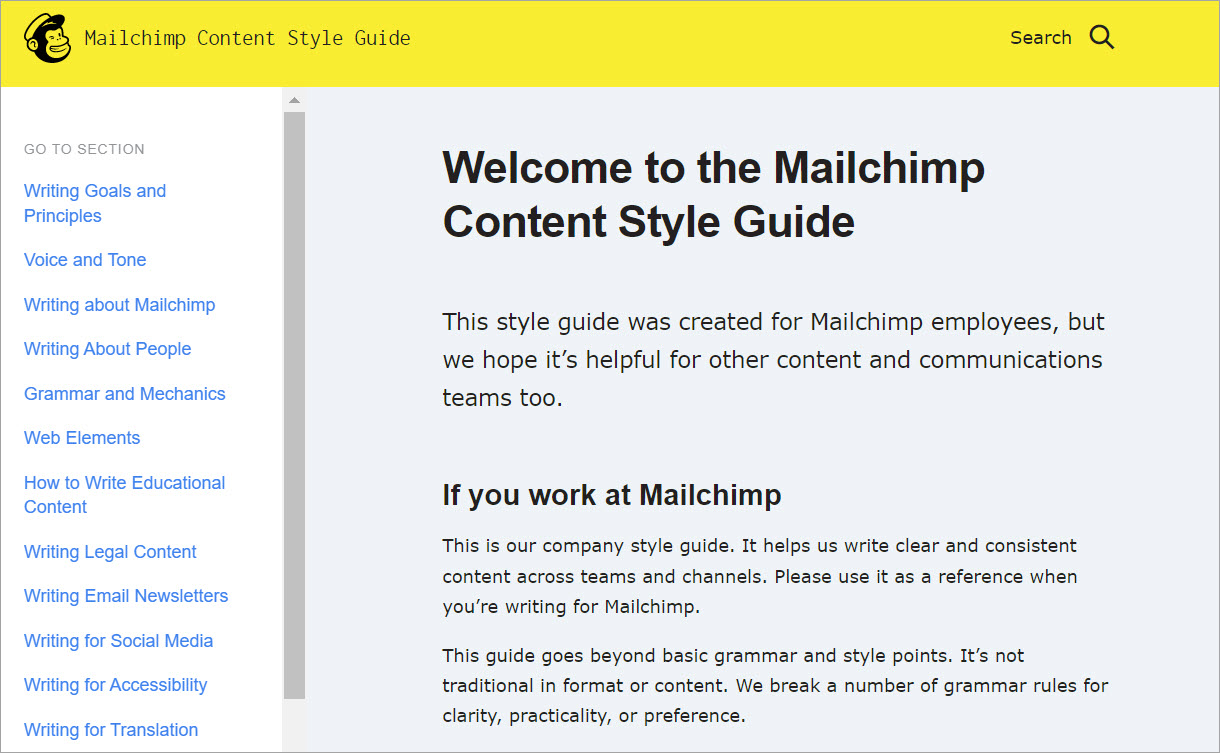
Mailchimp’s content style guide is a great example for establishing uniform tone of voice.
Brand Messaging: What You Say and How You Say It
Brand messaging includes your value proposition, key messages, taglines, and the specific language you use to describe your offerings.
Strong brand messaging speaks to your audience's real needs and desires. It addresses their problems, acknowledges their frustrations, and shows them a better way forward. It's not about listing features; it's about articulating the transformation you enable.
Your brand messaging should also include your compelling brand story—the narrative that explains why you exist and why it matters.
A good brand story isn't your company history (no one cares when you were founded). It's the journey from problem to solution, the insight that sparked your work, or the change you're working toward in the world.
Creating Your Brand Identity (The Visual Stuff)
Once your strategy and messaging are solid, it's time to bring it to life visually.
Remember: don't attempt this without your positioning defined, or you'll end up with a logo that looks nice but means nothing.
Logo Design: More Than Just Pretty
Your logo is the face of your brand; the most recognizable symbol of your business. A memorable logo is simple, distinctive, and appropriate to your industry and audience. It’s also flexible enough to work across different applications.
Think about the most famous logos: Nike's swoosh, Apple's apple, McDonald's golden arches. They're so distinctive that you recognize them without the company name. That's the power of good logo design.
But here's the thing: your logo is just one element of your brand identity. A beautiful logo won't save a confused brand strategy, and even the most successful brands need time to build that instant recognition.
Colors, Typography, and Visual Elements
Color psychology is real. Tons of research papers like this one will attest to the fact.
- Blue conveys trust and stability, which is why so many financial institutions use it.
- Red incites urgency and appetite (hello, fast food chains).
- Green represents growth and health.
Your color choices should align with both your brand strategy and your audience's expectations.
Typography matters too. The fonts you choose communicate personality before anyone reads a word.
- Serif fonts feel traditional and established.
- Sans-serif fonts feel modern and clean.
- Script fonts feel elegant or personal.
Choose fonts that reinforce your brand personality, not ones that contradict it.
These visual elements, including your colors, fonts, photography style, patterns, and design approach, come together to create your complete brand identity system.
Brand Guidelines: Your Consistency Playbook
Brand guidelines document how to use your brand identity correctly. They're not about being rigid; they're about maintaining consistency across every touchpoint.
Good brand guidelines include logo usage rules, color specifications, typography hierarchy, imagery style, and examples of how to apply everything correctly. They make it easy for anyone creating marketing materials to stay on brand.
Many successful brands publish their brand guidelines online as a single source of truth. This ensures everyone, from internal teams to external partners, can create on-brand content.
Our two favorites have to be Discord and Spotify. Take a look for some inspiration.
Bringing It All Together: The Branding Process
So how does all this actually work in practice? The branding process typically flows like this:
- Research and Discovery: Understand your market, your customers, and your competitors. What works in your space? What doesn't? Where are the gaps?
- Strategy Development: Define your positioning, ideal customer, brand promise, and key differentiators. This is your foundation.
- Messaging Framework: Create your brand voice, key messages, and brand story that bring your strategy to life in words.
- Identity Creation: Develop your visual identity system, including logo, colors, typography, and imagery, based on your strategy.
- Implementation: Apply your branding across all touchpoints, spanning your website, social media, marketing materials, customer experience, everything.
- Consistency and Evolution: Maintain your brand guidelines while allowing room to grow and refine over time.
Good branding doesn't happen overnight. It's an investment that requires research, dedication, and ongoing effort. But the payoff (think brand recognition, customer loyalty, and a business that stands for something) is worth it.
Of course, you don't need to have everything perfect before you start. Even finishing one or two parts of your branding is infinitely better than doing nothing.
Here's the truth: your early branding will be based on assumptions—educated guesses about what your customers need and what resonates with them. And that's completely okay. You need something concrete to test against reality.
Launch with what you have. Put it in front of real people. See what lands and what doesn't. Does your messaging resonate? Does your visual identity feel right? You won't know until you try.
Branding is iterative, not perfect.
Every interaction with your market gives you data. Every conversation reveals something new about your customers. Every campaign shows you what works. Use that information to refine your approach.
Think of your brand as a living thing, not a static document gathering dust in a folder somewhere. People change. Markets shift. Culture evolves. Your brand should too.
The key is consistency with flexibility. Stay consistent with your core message—who you are and what you stand for. But remain flexible in how you express it and willing to evolve as you learn more about your audience and yourself.
That's not being wishy-washy. That's being smart.
Common Branding Mistakes to Avoid
- Skipping strategy and jumping to design. Pretty visuals without a strategic foundation are just decoration.
- Trying to appeal to everyone. Brands that speak to everyone speak to no one.
- Inconsistency across channels. Your brand should feel coherent whether someone finds you on social media, your website, or in person.
- Copying competitors. Differentiation matters. If you look and sound like everyone else, why should customers choose you?
- Ignoring the customer experience. Branding isn't just visual and verbal; it's every interaction a customer has with you.
Why Good Branding Actually Matters
Let's get practical. Why invest in strong branding?
Customer Loyalty and Brand Loyalty
People buy from brands they trust and feel connected to. Effective branding builds that trust by creating consistency, delivering on promises, and showing up authentically. When customers feel aligned with your brand values and have positive experiences, they become loyal—and loyalty is more valuable than any one-time sale.
Brand Equity and Business Value
Strong brands are worth more. Brand equity is the additional value your business has because of your brand recognition and reputation. It's why people pay more for branded products than generic alternatives. It's why established brands can enter new markets more easily. Good branding is a business asset.
Competitive Advantage
In crowded markets, branding is often the differentiator. When products and services are similar, customers choose based on brand. The business with the clearer positioning, stronger identity, and better customer experience wins.
For small businesses, especially, strong branding can level the playing field against bigger competitors. You might not have their budget, but you can out-brand them with clarity, consistency, and authentic connection.
Marketing Efficiency
When your branding is dialed in, everything else gets easier. Content marketing flows from your brand voice. Digital marketing campaigns align with your brand messaging. Your social media presence reinforces your brand personality. You spend less time figuring out what to say and more time saying it effectively.
Clear branding also makes delegation easier. When you have brand guidelines and a defined voice, other people can create on-brand content without you micromanaging every word and pixel.
Your Human-First Brand Starts Here
We live in strange times. AI-generated content everywhere. Deepfakes. Polished Instagram grids that don't show the human behind the brand. The noise is very real.
That's exactly why human-first branding matters more than ever. People are craving real connection, authentic voices, and brands that feel like they're run by actual humans who care about something beyond profit.
Your brand doesn't need to be perfect. It needs to be clear, consistent, and genuinely you.
Start with strategy—get specific about who you're for and what makes you different. Build an identity that visually reinforces that strategy. Develop messaging that sounds like a human talking to another human. Then show up consistently across every touchpoint, from your website to your social media to how you answer customer emails.
The brands that win aren't the ones with the most polished facades. They're the ones that make people feel something real.
So, where are you in your branding journey? Maybe you have a logo but no clear positioning. Maybe you have a strategy, but your visual identity doesn't match. Maybe you're just starting and feeling overwhelmed by all of this.
Wherever you are, start with the foundation: know who you are for, get clear on what makes you different, and commit to showing up consistently as that brand. The rest builds from there.
And hey, if you need help translating all this into a brand that actually feels like you and connects with your people?
That's exactly what we do at Heartwired Club.
Get in touch, and we’ll help you with human-first branding that works.